
DR Congo Ebola outbreak – making a difference with the invisible
Knowledge is invisible. Confidence and trust are invisible. But these things can change lives, and ultimately change the world.
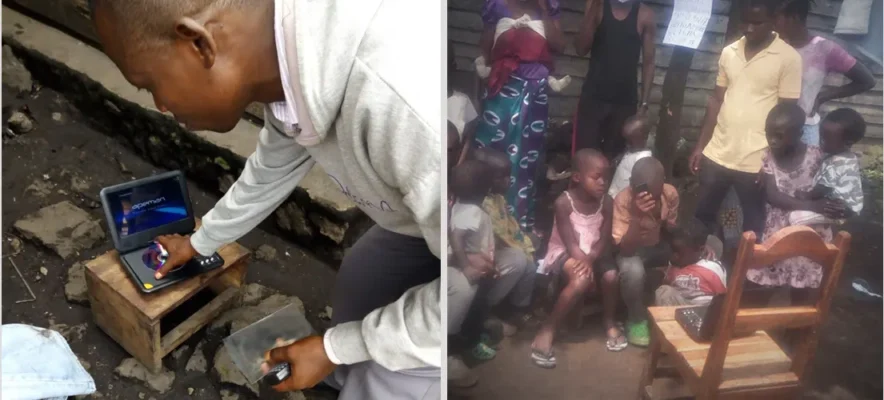
Education Saves Lives’ unique model of sharing health information through audio visual tools in local languages means that even people who’ve not had the chance to learn to read can access health information that can change their lives. Our lesson on avoiding Ebola was created in the early days of the 2014-16 Ebola outbreak in West Africa, and used by several organisations during that time. It is one of many in our library of lessons.
The hidden toll of an outbreak
However, it’s well documented* but not well reported that during an outbreak such as Ebola, mortality from other factors such as malaria, complications in childbirth, even road traffic accidents will also rise. Under-resourced health stations fill with suspected cases, while frightened people stay away for as long as they can. This was the case in west Africa, and we anticipate the data will show in time it is the case in the current outbreak too.
Reaching out to our friends
This is why, when Ebola was declared on 15 May 2026, our first response was to remind the many organisations we are in contact with in DR Congo, neighbouring Uganda and the surrounding region: “if you have our lessons, you already have tools that can help, now”. Our project partners can share information about Ebola, but also childhood diseases, malaria, the importance of safe water and a healthy diet (where that’s even possible). Using our lessons they can give knowledge and confidence to mums trying to keep their children safe, to girls and boys needing to understand what is happening to their bodies as they grow, to families unsure about the importance of immunisation, or unaware that puddles near their home are a breeding ground for dengue-carrying mosquitoes.
Reaching out to new communities
As well as supporting existing partners, we’ve also been sending lessons to new local partners in DR Congo, helping them to reach out to their communities in an area devastated by years of fighting, neglect and disease. One partner in Kivu-Nord province, who was using our lessons for the first time told us that after watching the lessons people were talking more about Ebola, and how to prevent it. They’d already used the lesson several times, showing it to about 240 people, and reported that people were washing hands more often, with soap – one of the simple steps that can help reduce risk.
Informed communities are safer communities
As of 23 September, 2026, more than 3750 people have died of Ebola in the DR Congo outbreak, the case fatality rate is nearly 50% (higher for children under 5**) and recent data indicates around 500 additional cases being confirmed every week***. Community sensitisation has been identified as a crucial component to halt the current outbreak, so knowing that the lessons are being used, and are making a difference, is a huge encouragement for us to continue providing support. We can’t claim to eliminate Ebola, and the suffering of impacted families, but we know that informed communities will be safer communities.
Simple lessons for safer living
Even a basic knowledge of risks and symptoms and preventative measures can build confidence – whether it’s Ebola, malaria, or cholera. We’re grateful to and for every organisation that engages with us and uses our lessons to support their communities. Every time they show someone a lesson, those invisible gains, however small and immeasurable, will ripple out beyond those who’ve watched, and passed on to neighbours, husbands, children, parents, friends.
Education saves lives – it’s simple
*Imperial College London https://www.imperial.ac.uk/news/165212/ebola-affected-countries-suffered-over-10000-extra/)
** United Nations https://news.un.org/en/story/2026/09/1168407
*** WHO data shows 967 cases confirmed between August 28 and September 10 https://www.who.int/emergencies/disease-outbreak-news/item/2026-DON617


